
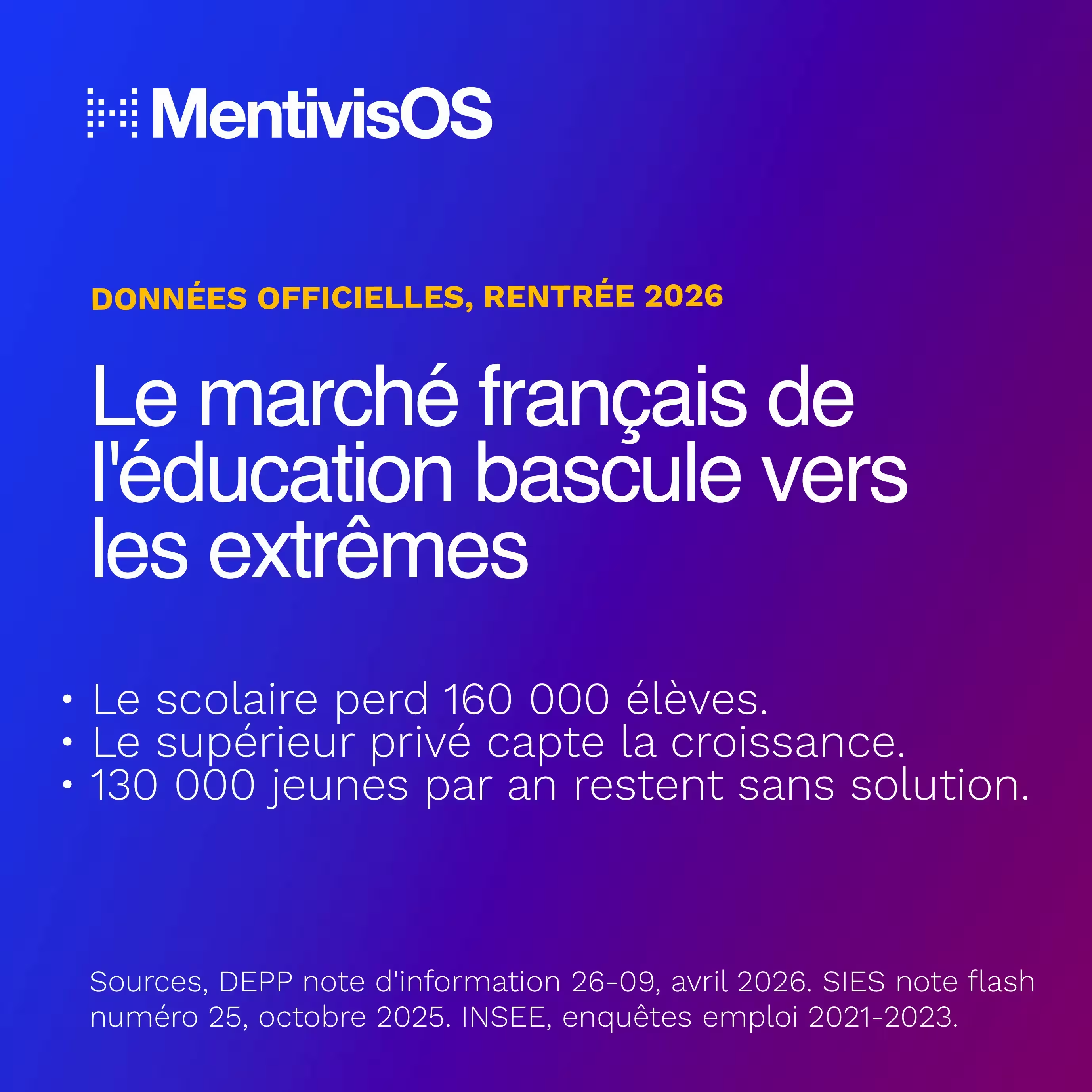
Framing note, official figures, 2025 versus 2026 comparison, focus on young people without the baccalauréat. Sources: DEPP, SIES, INSEE, DARES.
1. Overview, forecast enrolments for the 2026 intake
Three broad blocks to distinguish, with opposing dynamics between school education and higher education.
| Segment | Enrolments, 2025 intake | Forecast enrolments, 2026 intake | Change |
|---|---|---|---|
| Primary education, public plus private under contract | 6 149 500 | 6 024 100 | down 125 400, i.e. down 2,0 % |
| Secondary education, public plus private under contract | 5 619 700 | 5 583 500 | down 36 200, i.e. down 0,6 % |
| Higher education, total France | 3 027 000 | 3 046 800 | up 19 800, i.e. up 0,7 % |
| Total school education, primary plus secondary | 11 769 200 | 11 607 600 | down 161 600, i.e. down 1,4 % |
Reading. Schools lose 160 000 pupils in a single intake, the sharpest fall recorded by the DEPP. Higher education, by contrast, continues to grow slightly, but more slowly than in the 2010s.
Primary source, DEPP, Projections d'effectifs d'élèves à horizon 2035, information note No 26-09 published 7 April 2026. Higher education source, SIES, flash note No 25, enrolment forecasts of October 2025.
2. Public and private breakdown in higher education
This is where the dynamic is most interesting and most strategic for private providers.
Of the 3,04 million students at the 2026 intake, growth is very unevenly distributed.
| Sub-sector | 2025 versus 2026 trend |
| --- | --- | --- |
| Public universities | Moderate growth, driven by certain disciplines |
| Business schools | Sustained growth |
| Engineering schools | Sustained growth |
| Private institutions in the broad sense | Most dynamic growth |
| BTS and STS | In decline |
In other words, we are seeing two-speed higher education. Private schools and grandes écoles capture the growth, while the BTS, the traditional post-baccalaureate route into employment, declines. This is not a short-term development, it is a structural movement confirmed for the third consecutive year.
Source, SIES, flash note No 25 of October 2025.
3. Focus, young people without the baccalauréat and early leavers
A point often overlooked in analyses centred on higher education. Of 100 young people leaving the French education system each year, the breakdown is as follows, according to DEPP and INSEE data finalised in 2024.
| Exit level | Share | Detail |
|---|---|---|
| Higher education graduates | 52 % | Bac +2 to bac +5 and above |
| Secondary education graduates | 38 % | 29 % with a general, technological or vocational baccalauréat, 9 % with a CAP, BEP or equivalent |
| Leaving with no diploma or with only the brevet | 10 % | 6 % with only the DNB, 4 % with no diploma at all |
Translated into volumes, this represents around 90 000 young people each year who leave the system with no secondary-level diploma, including around 36 000 with no diploma at all.
A more concrete figure for labour market entry. Six months after leaving lycée or a CFA, 73 % of lycée pupils are in employment, but only 46 % of CAP holders are in work. The gap between the two says most of what matters about the French problem, a system where the general lycée leads somewhere, where the vocational lycée and the CAP often lead nowhere without a further step.
Areas most affected by non-graduation, Hauts-de-France, with 12 % of 16 to 24-year-olds neither qualified nor in education, compared with 8,7 % in metropolitan France, according to INSEE.
Sources, DEPP, L'éducation nationale en chiffres, 2025 edition, published August 2025. DARES and DEPP, InserJeunes, January 2024. INSEE, employment surveys 2021 to 2023. INSEE, Analyses Hauts-de-France No 107.
4. What is changing in vocational training and apprenticeships
National spending on vocational training and apprenticeships is 56,6 billion euros in 2024, i.e. 1,94 % of GDP, slightly down on 2023, according to DARES. The State cut its funding to France Compétences from 1,6 billion in 2024 to 850 million in 2025, with cuts to apprenticeships and a restriction of the CPF (French personal training account) planned in 2026.
The paradox. Companies adopt AI faster than they train, and the State reduces training funding just as the need for reskilling increases structurally. This is not an ideological choice, it is an imposed budget constraint.
5. Interpretation, what these figures really tell us
Three readings that go well beyond the raw figures.
Firstly, French schools are entering a decade of historic demographic contraction. Losing 160 000 pupils in one intake is not an accident, it is the start of a trajectory that will see 1,7 million fewer pupils by 2035, i.e. a 14 % fall in the total school population. The consequences are massive, school closures, teacher redeployment, pressure on school property, and above all, a mechanical fall in the pool of students entering higher education by 2030.
Secondly, French higher education is shifting towards the private sector. Growth in enrolments is concentrated almost entirely in business schools, engineering schools and private institutions in the broad sense, while the BTS declines. The traditional public model, mass universities plus BTS routes into work, is losing ground to a private sector that captures both growth and perceived value. This movement will strengthen, not reverse.
Thirdly, the 10 % who leave with no diploma are the permanent blind spot of French public policy. That is around 90 000 young people per year, plus poorly integrated CAP holders who add a second wave, i.e. more than 130 000 young people each year for whom the system fails to fulfil its role in supporting entry into work. No recent plan targets them specifically at large scale. This is precisely the segment that would benefit most from personalised access to training, free or near-free, with no administrative barrier. Yet it is also the segment towards which public funding and private providers turn least, because it has neither the purchasing power of private school students, nor the administrative structure of OPCO (French vocational training funding body) schemes for employees in post.
In summary, the French education market in September 2026 is characterised by school education shrinking fast, higher education shifting to the private sector, continuing training under budget constraint, and an unqualified population durably left on the margins. The winners will be those who can address the two extremes of this market, either the top end of private schools capturing growth, or vulnerable groups that no one seriously funds but which represent a massive social and economic need.
Main sources
Ministère de l'Éducation nationale, DEPP, Projections d'effectifs d'élèves à horizon 2035, information note No 26-09, 7 April 2026, https://www.education.gouv.fr/depp/projections-d-effectifs-d-eleves-dans-les-premier-et-second-degres-horizon-2035-504275
Ministère de l'Enseignement supérieur, SIES, Flash note No 25, Prévisions des effectifs dans l'enseignement supérieur rentrées 2025 et 2026, October 2025, https://www.enseignementsup-recherche.gouv.fr/fr/previsions-des-effectifs-dans-l-enseignement-superieur-rentrees-2025-et-2026-100152
Ministère de l'Éducation nationale, DEPP, L'éducation nationale en chiffres, 2025 edition, August 2025, https://www.education.gouv.fr/depp/l-education-nationale-en-chiffres-edition-2025-452838
DARES and DEPP, InserJeunes, January 2024 data.
INSEE, Formations et emploi, Niveau de formation, 2021 to 2023 data, https://www.insee.fr/fr/statistiques/8305502
INSEE, Analyses Hauts-de-France No 107, Un jeune sur huit non scolarisé et non diplômé, https://www.insee.fr/fr/statistiques/4251578
Banque des Territoires, Baisse des effectifs scolaires, dispatch of 8 April 2026, https://www.banquedesterritoires.fr/baisse-des-effectifs-scolaires-des-previsions-dix-ans-preoccupantes
France Info, Rentrée scolaire 2026, 21 élèves par classe dans le premier degré, October 2025, https://www.franceinfo.fr/replay-radio/le-vrai-du-faux/rentree-scolaire-2026-y-aura-t-il-21-eleves-par-classe-dans-le-1er-degre-comme-l-affirme-le-nouveau-ministre-de-l-education_7543567.html
Note, all figures cited come from official French sources published between October 2025 and August 2026. DEPP and SIES projections are forecasts, not observed data, and may be marginally revised after the actual September 2026 intake.
Mentivis, autumn 2026.