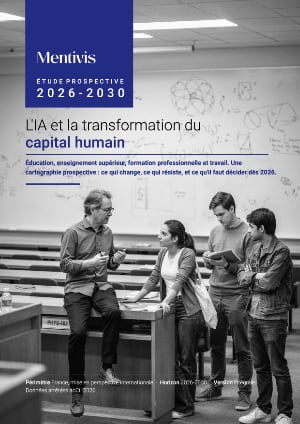
Between 2026 and 2030, artificial intelligence will profoundly transform how we learn, teach, assess and validate skills. But this transformation will be neither uniform nor instant: it will affect universities, grandes écoles, private schools, training organisations and vocational training differently.
This foresight study analyses the main upcoming disruptions and seeks to answer a central question: what becomes of the value of an education or training institution when AI makes content abundant, individualised tutoring accessible and traditional assessment increasingly fragile?
The finding: value shifts from content to support
The finding is major: the value of education will gradually shift from content towards what AI reproduces less easily, namely support, experience, scenario-based learning, validation, proof of skills and social capital. Training organisations based solely on producing standardised content are thus among the most exposed, while institutions able to offer a differentiating experience, a network, research or genuine skills transformation have new levers.
The pedagogical break: AI tutors, adaptive learning paths and authentic assessment
The other break is pedagogical. AI tutors and adaptive learning paths make personalisation possible at a scale previously hard to reach. At the same time, assessment must be rethought: remote exams, essays and outputs easily generated by AI progressively lose their value as proof of skills. The institutions must therefore move towards more authentic assessment, scenario-based assessment, oral work and skills portfolios.
The challenge for education actors is therefore no longer simply adopting AI, but understanding how it transforms their pedagogical model, their value proposition and their business model.
How Mentivis can support you
Mentivis supports education and training institutions in this transformation at three levels.
Diagnose
Identify the courses, pedagogies, processes and sources of value most exposed to AI, but also those that can be strongly enhanced.
Rethink the education model
Reposition learning paths around personalisation, AI tutoring, experience, scenario-based learning and proof of skills. The aim is to move from a model centred on content transmission to a model centred on real skills development.
Deploy
Turn this strategy into concrete programmes: redesigned assessment, AI-augmented learning paths, acculturation of teachers and trainers, modularisation of courses and integration of AI solutions at scale, notably with MentivisOS. The study's recommendations place these transformations among the priorities to start in 2026.
Our conviction
The institutions that win will not be those that add the most AI to their current model, but those that can rethink their education model from what AI now makes possible.